Montauk has always had a split personality, and that is exactly what makes it so compelling. You can still feel the fishing village, surf-town grit, and weathered cedar history, but you can also see how design-forward homes and hospitality have reshaped the market. If you are trying to understand what Montauk looks like now, how buyers are valuing it, and why certain properties command a premium, this guide will help you read the market with more clarity. Let’s dive in.
Why Montauk Feels Different
Montauk sits at the eastern edge of Long Island in the Town of East Hampton, and it has long been shaped by fishing, grazing, seasonal use, and a major public-land footprint. That alone gives it a different rhythm from other Hamptons enclaves. It feels less like a polished resort town built all at once and more like a place that evolved in layers.
Those layers still show up in the built environment. Historic structures tied to cattle-keeping, barns, resort-era remnants, and preservation-minded properties all contribute to a setting where adaptation often matters as much as new construction. In Montauk, the most interesting homes often feel connected to the landscape instead of imposed on it.
NYS Parks notes that Montauk Point State Park anchors the eastern tip, and the adjacent Montauk Lighthouse is the oldest lighthouse in New York State, commissioned in 1792. The Montauk Historical Society also points to the hamlet’s transition from remote fishing village to summer resort, a shift that helps explain why preservation and reinvention remain central to the local identity.
From Surf Shacks to Design Retreats
For years, Montauk’s image was built around shingled motels, practical fishing-town buildings, and an unfussy surf culture. That visual language still matters, and buyers still respond to homes that feel authentic to that past. But the market has moved well beyond the original surf-shack stereotype.
Today, Montauk’s design story is more curated. Hospitality projects have helped push the aesthetic toward cedar, natural woods, plaster, quiet palettes, and a more intentional version of beach living. The result is a look that still feels relaxed, but it is more edited, more architectural, and often more luxurious.
That shift matters if you are buying or selling here. In many cases, the market rewards a home that reads like a private retreat rather than a standard beach house. Buyers are often paying for the full experience of the property, not just square footage or bedroom count.
Hotels Shaped the New Montauk Look
If you want to understand where Montauk design is heading, look at its hotels. They have become the clearest expression of the town’s aesthetic evolution and often serve as a preview of what buyers now want in residential properties.
Properties like Marram brought a neutral-toned, low-slung, barefoot-luxury feel into sharper focus. Other hospitality concepts have leaned into community-driven retreats, layered residential interiors, and adaptive reuse of older buildings. Together, they helped redefine Montauk as a place where surf culture and refined design can coexist.
That influence is easy to spot in the housing market. Many sought-after homes now borrow directly from hospitality, with indoor-outdoor flow, calm material palettes, built-in wellness features, and highly considered finishes. The strongest properties feel effortless, but that effect is usually the result of careful design choices.
The Dominant Montauk Styles
Barefoot Modern
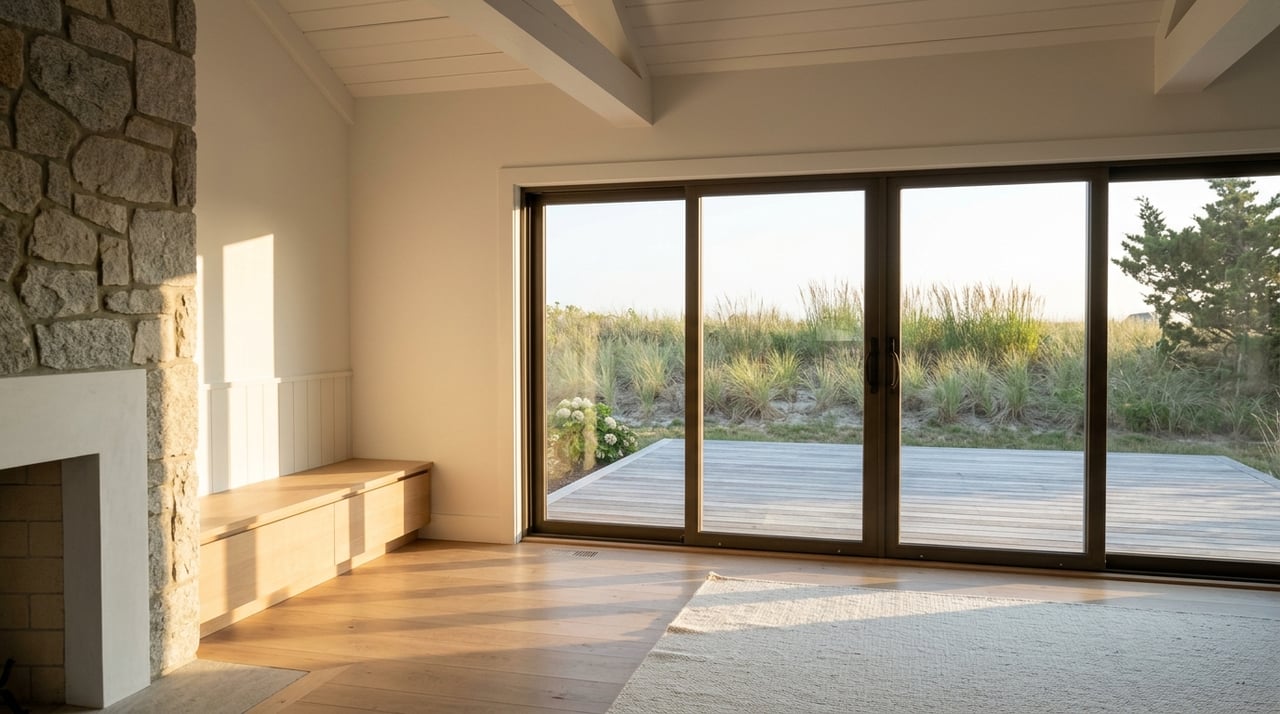
This is the clearest current design language in Montauk. You will often see cedar exteriors, white oak, plaster walls, natural stone, low horizontal profiles, and large openings that connect interior rooms to decks, pools, or dune-facing outdoor space.
The appeal is simple: the homes feel calm, tactile, and tied to the site. Weathering materials and restrained detailing often work especially well here because they reflect Montauk’s coastal setting rather than fighting it.
Midcentury Surf-Era Influence
Montauk also has a strong midcentury second-home legacy. The Montauk Historical Society’s Leisurama exhibit highlighted a 1965 development designed as an affordable option for middle-class families, using clean and practical midcentury modern architecture.
That history still shapes buyer taste. Smaller cabins, compact compounds, and simple rooflines often feel authentic in Montauk, even when they have been fully renovated and upgraded.
Polished Coastal Luxury
At the upper end of the market, some homes push the aesthetic into a more resort-driven direction. You may see more glass, deeper landscaping, stronger arrival sequences, and a finish level that feels more tailored and refined.
This is still Montauk, but with a more elevated presentation. For some buyers, that balance between relaxed coastal living and polished execution is exactly the point.
Adaptive Reuse
One of Montauk’s most important design themes is working with existing structures. Rather than clearing a site and starting over, many compelling projects rework older shells, cottages, or bungalows into something fresh.
That approach fits the area’s history and its physical constraints. It also means a well-executed renovation can carry just as much prestige as a ground-up build, especially when the finished product feels true to place.
Why Smaller Footprints Still Matter
In some luxury markets, bigger almost always wins. Montauk is not quite that simple. Smaller homes, cottages, and condos can still hold strong appeal when they offer a coherent lifestyle, smart design, and a close connection to beach access or views.
That is partly because Montauk’s authenticity is tied to modest forms as much as grand ones. A compact property with clean lines, strong materials, newer systems, and a thoughtful renovation can feel more aligned with the market than a larger home that misses the local design language.
For buyers, this creates a useful lens. You are not only evaluating size and finish, but also whether the home feels believable in Montauk.
What Prices Look Like Right Now
Montauk remains a luxury market, but it is not the most expensive part of the Hamptons. Zillow’s April 30, 2026 market page estimates a typical home value of $1,979,577, with 78 for-sale listings and a median list price of about $1.80 million.
That positioning is easier to understand when compared with nearby benchmarks. The same source shows much higher typical home values in East Hampton Village and Sagaponack, which helps place Montauk as expensive, design-conscious, and highly desirable, while still offering some relative value within the broader Hamptons context.
On the luxury side, Redfin’s Montauk luxury page shows 19 luxury homes with a median listing price of $2.4 million. In practice, that means many buyers enter Montauk expecting seven-figure pricing, with the premium moving quickly higher for standout locations, turn-key condition, or strong views.
Entry Points and Premium Tiers
Montauk does offer a broad range of inventory, even if the market skews upscale. Current condo and co-op examples appear around $399,000, $499,999, $829,000, and $899,000, while other condo listings climb to $3.6 million and $3.95 million.
Single-family inventory stretches much higher. Current examples range from about $1.8 million to $17.5 million, including listings around $2.75 million, $3.585 million, $8.995 million, and $17.495 million.
For many buyers, that means the lower entry points often appear in condos, co-ops, or smaller-footprint homes. Oceanfront settings, newer construction, larger view properties, and highly curated turn-key homes usually sit in the multimillion-dollar tier.
What Usually Drives a Montauk Premium
In Montauk, value is rarely about size alone. Premium pricing is usually tied to a bundle of features that work together to create a complete lifestyle proposition.
The factors that often matter most include:
- Direct or easy beach access
- View corridors
- Turn-key design
- Newer mechanical systems
- A clear and intentional aesthetic
- Strong indoor-outdoor flow
In other words, buyers are often paying for coherence. A property that feels finished, functional, and visually aligned with Montauk’s current design language tends to stand out more than a home that simply checks standard luxury boxes.
Why New Development Is More Limited
Montauk’s physical and regulatory context also shapes the market. The large amount of surrounding public land and parkland means broad subdivision-style growth is less common here than in places with fewer constraints.
That reality helps explain why adaptive reuse and selective infill are such important parts of the local housing story. Buyers looking in Montauk are often choosing among renovated cottages, reimagined older homes, and carefully positioned new builds rather than endless waves of fresh inventory.
For sellers, this can be an advantage when a property has been improved thoughtfully. Scarcity, especially when paired with design quality, can strengthen positioning.
How to Read a Montauk Property Well
If you are considering a purchase in Montauk, it helps to evaluate a home through both a lifestyle lens and an asset lens. The best opportunities often sit at the intersection of location, design credibility, and practical readiness.
A few questions can help:
- Does the home feel true to Montauk’s setting?
- Is the design intentional or just recently updated?
- Are the materials and systems likely to age well in a coastal environment?
- Does the property deliver the retreat-like experience buyers now expect?
- If you sold in the future, would the home stand out visually in listing photography and marketing?
These are not abstract design questions. In a market like Montauk, they directly influence desirability and pricing.
What This Means for Buyers and Sellers
For buyers, Montauk offers a mix of authenticity and polish that is hard to replicate elsewhere in the Hamptons. You can still find properties with surf-era DNA, but the market increasingly rewards homes that translate that heritage into a more refined and livable retreat.
For sellers, presentation matters. A home does not need to be the largest or newest in the market, but it should feel cohesive, well-positioned, and aligned with what today’s Montauk buyer is actually seeking.
That is where local market reading becomes critical. In a place where architecture, branding, and lifestyle are so closely linked, pricing and marketing strategy need to reflect more than comps alone.
If you are considering a move, a second-home purchase, or a discreet sale in the Hamptons, Alison Graham brings a measured, high-touch approach grounded in market analysis, thoughtful positioning, and boutique-luxury service.
FAQs
What style defines Montauk homes today?
- Montauk’s dominant style is barefoot modern, often mixing cedar, natural materials, low profiles, and indoor-outdoor flow with surf-era or midcentury references.
What do Montauk entry-level prices look like?
- Current examples show condo and co-op entry points from the high-$300,000s to the high-$800,000s, while many single-family homes begin well above $1.8 million.
Why do some Montauk homes command a premium?
- Premiums are often driven by beach access, views, turn-key condition, newer systems, and a clear design identity that feels like a private retreat.
Is Montauk still a surf town or more polished now?
- It is both. Surf culture remains part of Montauk’s identity, but hotels and custom homes have pushed the market toward a more curated, design-forward version of coastal living.
Why is adaptive reuse so common in Montauk real estate?
- Adaptive reuse is common because Montauk has a strong preservation mindset, a layered building history, and a landscape shaped by significant public land and parkland constraints.