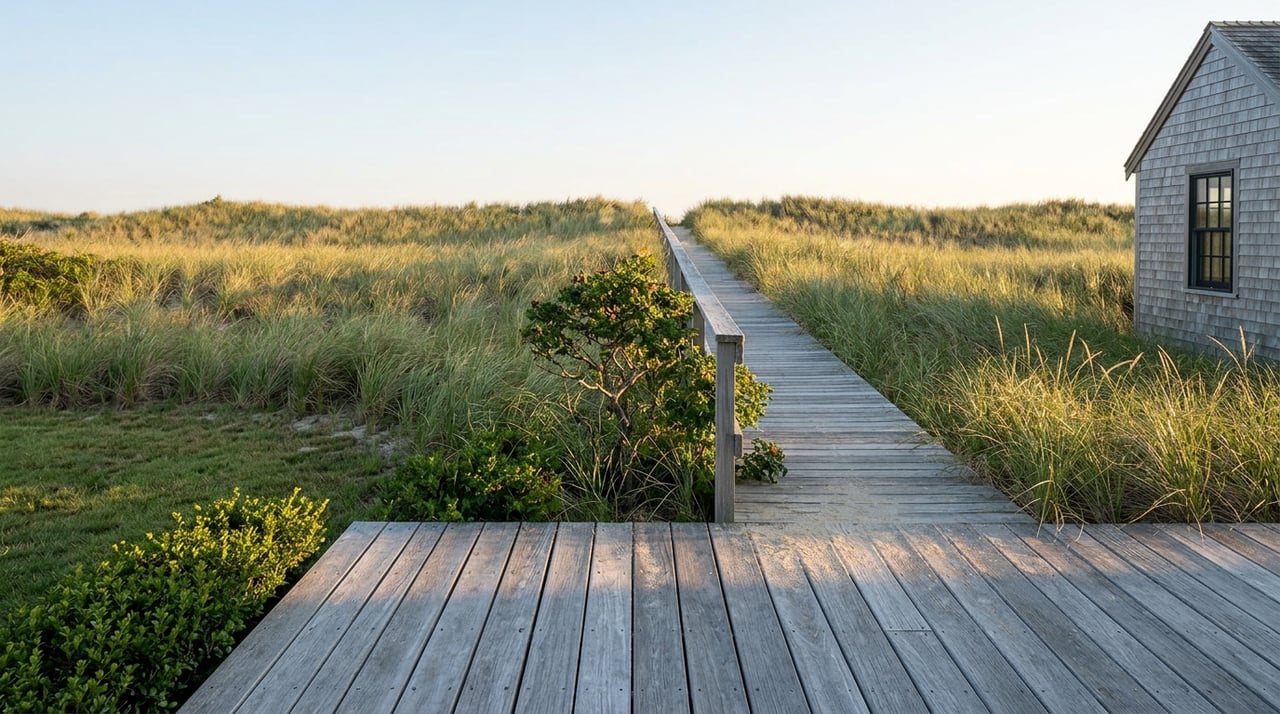
A lawyer once stood before the East Hampton Town Trustees to complain that a client's Georgica Pond lawn was underwater because the Trustees hadn't opened the pond to the sea on schedule. He got a reply that has circulated in town meetings ever since: the pond wasn't on his client's lawn. His client's lawn was under the Trustees' pond.
That exchange is not a joke about small-town bureaucracy. It is the plainest possible statement of a legal fact that catches waterfront buyers off guard in East Hampton more than almost anywhere else on the East Coast: your deed does not automatically tell you where your property ends and public land begins. A separately elected board older than the United States often gets the final word, and in some of the town's most contested stretches of sand, nobody has gotten a final word at all.
A Board Older Than the Town Board
The East Hampton Town Trustees trace their authority to the Dongan Patent, granted in December 1686 by Governor Thomas Dongan on behalf of King James II. The patent created a body called the Trustees of the Freeholders and Commonalty of the Town of East Hampton and gave it title to the town's beaches, underwater lands, and common areas, to be held in trust for residents rather than owned outright by any single official. That structure predates the current Town Board. A federal court opinion describes the Trustees as elected separately from the Town Board. They still meet regularly to issue permits, manage shellfish beds, and rule on beach access questions that have nothing to do with zoning or the building department.
This is not a East Hampton-only curiosity, but it is close. The same colonial trustee structure survives in only two other New York towns, Southampton and Southold. Every other town on Long Island saw its version eliminated over the past three centuries. If you have bought waterfront property elsewhere in the country, or even elsewhere in the Hamptons in a village without this history, there is a good chance you have never had to think about a body like this before.
What It Actually Requires of an Owner
The Trustees claim ownership of ocean beaches from mean low water to the grass line at the base of the dunes, and they generally claim the same zone on bay and harbor beaches, from the low water mark to the base of the dune or bluff.
The Trustees' General Permit application lists a first-application fee of $125 and one renewal fee of $100, but the restriction behind it is not. New bulkheads are generally not permitted at all except in cases of imminent danger to an existing structure. Erosion-control fencing installed on ocean-beach properties has to come down by March 15 each year. None of this shows up in a standard home inspection.
The Line That Is Still Being Drawn
If the permit requirements were the whole story, this would be a manageable piece of due diligence, one more call to make before closing. What makes East Hampton different is that the boundary itself, the line between private title and Trustee land, was litigated on a 4,000-foot stretch of Napeague oceanfront known locally as Truck Beach, and, as the East Hampton Star reported, the most recent ruling only came down in 2023.
The East End Beacon reported that the dispute centers on an 1882 deed in which the Trustees conveyed roughly 1,000 acres on Napeague to a private buyer, Arthur Benson, while reserving certain rights for the public. The East Hampton Star reported that the scope of those reserved rights has been disputed in court.
| Year | What happened |
|---|---|
| 2016 | State Supreme Court sides with the town, citing the 1882 deed's public-use reservation |
| Feb. 2021 | The East Hampton Star reported that the Appellate Division reversed course, ruling the private titles extend to the mean high water mark |
| Sept. 2021 | New York's Court of Appeals rejects the town's bid to revisit that reversal, closing out the original case in the property owners' favor |
| 2022 | The East Hampton Star reported that the Town revoked existing beach driving permits; Trustees and a group of fishermen filed a new class action over what the reservation actually covers |
| Mar. 2023 | Justice Paul J. Baisley Jr. dismisses the trustees' and fishermen's claims and bars further filings on the scope of the reservation without court approval |
Attorney's fees alone in this dispute ran into hundreds of thousands of dollars, billed to both sides. As of that March 2023 ruling, the most recent public record of the case, the presiding judge told everyone involved to stop relitigating the same question. Whether that holds for good is not something anyone can promise. It has not held before.
The lesson for a buyer is not that Truck Beach will happen to you. Most parcels in town have never been part of a lawsuit. The lesson is that "my deed says my property runs to the water" is a claim East Hampton spent over a decade testing in court on one specific beach, with the outcome flipping once and then holding through two further rounds of litigation. A title company can tell you what your deed says. It cannot always tell you whether that language has been tested against the Trustees' claim, or whether it might be someday.
Why This Doesn't Slow the Market Down
None of this has cooled demand for East Hampton oceanfront. In March 2026, a 3.6-acre estate on East Dune Lane, sited between the Atlantic, Hook Pond, and the Maidstone Club golf course, closed at $72 million, one of the largest deals in the Hamptons so far this year. Buyers at that level are not deterred by the existence of a Trustee permit system or a beach access case a few miles away in Napeague. If anything, the complexity is priced in and managed by counsel as a matter of course.
What it means for anyone below that price point, and for anyone buying without a full legal team already engaged, is that the diligence that protects a $72 million buyer is worth doing at every price. A survey that clearly marks the mean high water line. A check of the Trustees' permit history for the parcel. A conversation, before you're under contract, about whether the specific stretch of shoreline in question has ever come up in a Trustees' meeting or a court filing.
Where Ali Can Help
None of this is a reason to avoid waterfront property in East Hampton. It is a reason to treat the shoreline itself as part of the deal, not an assumed feature that came with the price. If you are comparing waterfront parcels across neighborhoods, our guide to choosing an East Hampton neighborhood is a useful next stop before you narrow your search further.
A Short FAQ
Does the Trustees' claim apply to pond-front and bay-front homes, or only ocean? Both. The Trustees generally claim beach areas along the bays and harbors the same way they claim ocean beach, from the low water mark to the base of the dune or bluff, in addition to named water bodies listed in the East Hampton Town Code, including Georgica Pond, Three Mile Harbor, and Napeague Harbor.
Does buying inside East Hampton Village change any of this? The East Hampton Village permit portal lists Main Beach, Georgica Beach, Wiborg Beach, Egypt Beach, and Two-Mile Hollow Beach.
Buying waterfront in East Hampton means buying into a piece of the town's oldest institution along with the house. The right team makes sure you know exactly what you are taking on before you sign, not after. Alison Graham works with waterfront buyers across the Hamptons to get that groundwork done early. Get your instant home valuation to start the conversation about what your next move actually involves.
This article is general information, not legal, tax or financial advice. Consult a qualified professional about your situation.