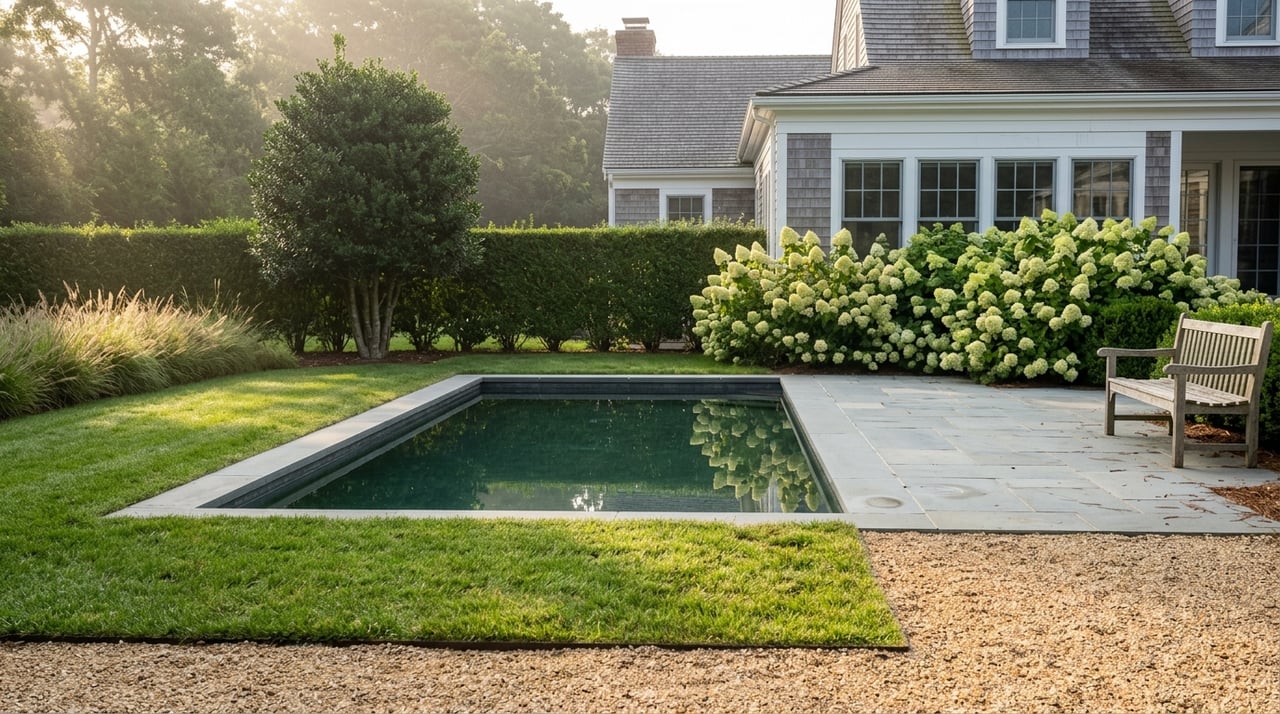
Four years ago, the 1920s building at 136 Main Street was headed for the wrecking ball. Its owners had floated a plan to level it, along with the red barn behind it, and put up an office suite, twelve retail stores, and four affordable housing units on the site. The East Hampton Town Planning Board said no. The parcel sat quiet for a while after that, part of a stretch of Main Street that, as recently as two winters ago, still felt like a block you drove past rather than a block you stopped at.
This year, that same building holds a coffee shop and a bookstore, with a restaurant and a salon within thirty feet of them. The building didn't get bigger. The plan that would have made it bigger got rejected. What arrived instead is smaller, quieter, and apparently sturdy enough that the town is spending real money on the sidewalk in front of it.
What the Rejected Plan Would Have Looked Like
It's worth sitting with the scale of what almost happened, because it explains why what did happen reads so differently. The 2022 proposal for 136 Main Street wasn't a single new tenant or a facade update. It called for demolishing both structures on the lot and replacing them with an office building, a dozen retail spaces, and four housing units, a genuine commercial development at the western gateway to the hamlet.
| The 2022 Proposal | What's There Now | |
|---|---|---|
| Structures | Demolition of the 1920s building and the red barn | Both buildings still standing |
| Commercial space | Offices plus twelve retail stores | Four small, independently run businesses |
| Housing | Four affordable units | None built |
| Outcome | Rejected by the East Hampton Town Planning Board | Organic, tenant-by-tenant fill-in over several years |
The Planning Board's rejection didn't restore the block to nothing. It left a vacancy that took roughly four years to fill, and what filled it was not a developer with a master plan but a handful of people who already lived on the East End and decided this particular corner was worth the risk.
Who Actually Moved In
SETT Coffee took a space in that cluster, opened by John and Kelly Piccinnini, who also own the Clam Bar and previously ran The Corner in Sag Harbor. Next door, Sea Dragon Books is run by siblings Tricia Hoefling and Charles Billings, along with their mother, all three Sagaponack residents who apparently decided the hamlet needed a bookstore and built one rather than waiting for someone else to.
Neither business is trying to be a destination. That's the point. A coffee shop, a bookstore, a restaurant, and a salon sitting within thirty feet of each other at the western entrance to Amagansett is a different kind of commercial bet than twelve retail stores under one roof would have been. It's four separate people, each running a small operation, each willing to be wrong on their own rather than as part of someone else's larger plan.
The town's own behavior backs up the read that this isn't a fluke. The south-side sidewalk on Main Street is currently being rebuilt in brick, a capital project that only makes sense if the foot traffic generating the wear is expected to keep coming. Towns don't repave for a business cluster they think is a summer novelty.
The Anchors That Didn't Need Reinventing
None of this replaces what was already working. Amber Waves Farm, the nonprofit market and cafe at 367 Main Street, remains the hamlet's eastern anchor, open daily with cafe service running Friday through Tuesday. A few blocks toward the center, Amagansett Square still runs on the same rhythm it's kept for years: Vinnie & Nick's Barber Shop, cash-only and open since 6:30 in the morning, has been a fixture there for 45 years. Jack's Stir Brew has poured coffee at the Square since 2010. Cavaniola's Gourmet still stocks the cheese counter, minus the wine shop that its original Sag Harbor location carries.
Doubles, the Caribbean-influenced spot that brothers Daniel and Evan Bennett opened in the space Hampton Chutney vacated after two decades, tells its own small story about how this stretch has changed. A year ago it operated on a limited schedule and got treated as a novelty. This year it's part of more residents' regular rotation, which is a better measure of a restaurant's standing in a place like Amagansett than any review ever could be.
And down at 1980 Montauk Highway, LUNCH Lobster Roll opened for its 2026 season on April 24, running Thursday through Monday through the spring before expanding to seven days a week by mid-June. The lobster roll itself, cold-water meat mixed with a house mayo dressing and celery, hasn't changed in a decade. In a hamlet where four new businesses just filled in a formerly dead block, the fact that LUNCH hasn't touched its recipe in ten years is its own kind of information.
What a Full Week Actually Looks Like
Stack the recurring calendar against the new openings and the picture gets clearer: this isn't a single new hot spot, it's a week that now has more places to be on any given day.
- Thursdays, 3:30 to 6 p.m., through September: the farmers market at Amagansett Square, with live busking
- Saturdays, 9 to 10 a.m., through August: outdoor morning yoga in the Square
- Alternating Thursdays, 10 to 11 a.m., through September: Tai Chi at LongHouse Reserve, a five-minute drive away in East Hampton
- Fridays and Saturdays, 7 p.m. to 3 a.m.: live music at the Stephen Talkhouse on Main, a venue that's booked touring and local acts since 1987
- Through August 31: "Artists Meet the Sea: In Search of the Divine" at ARC Fine Art on Montauk Highway
None of these is new this year. What's new is that a Saturday morning that used to run from the Square to Amber Waves Farm and stop can now keep going west past Hedges Lane without hitting a dead block.
Why the Sidewalk Is the Real Story
It would be easy to write this up as a list of openings and call it a season. The more interesting fact is the sequence: a demolition proposal got rejected, the block sat empty for a stretch, and then it filled back in one tenant at a time, at a scale nobody planned centrally. That's a harder thing to engineer than a mixed-use development, and it's arguably more durable, because it isn't dependent on one landlord's financing or one developer's exit timeline.
The brick sidewalk is the tell. Infrastructure spending is a slower, less glamorous signal than a restaurant opening, but it's the one that's hardest to fake. A town doesn't rebuild a sidewalk for a block it expects to go quiet again next winter.
Whether the specific tenants at 136 Main Street are still there in five years is impossible to know. Storefronts turn over, leases end, buildings change hands. What seems more durable is the pattern itself, that this hamlet keeps choosing small and slow over big and fast when the choice actually gets made. The Planning Board made that choice explicitly in 2022. The businesses that filled the vacancy afterward made it implicitly, one lease at a time.
If you already live in Amagansett, none of this requires a decision from you beyond which direction to walk on a Saturday morning. But it's a useful data point if you're the kind of person who pays attention to how a place actually behaves over time, not just what it advertises in July.
Whenever the day comes that you're thinking about a move within the Hamptons, or want a read on how a specific block is trending before you commit to it, Alison Graham has spent enough time on this stretch of the East End to tell you which changes are structural and which are just this summer's weather. Reach out through ali-graham.com when you're ready to talk.